|
|
|
|
|
|
|
|
|
|
|
|
|
|
|
|
|
|
|
| Text for the above items : |
Our Captain Hailed the Frenchman - Ho! by Archibald Webb. (PC) The captain of the HMS Arethusa makes contact with the French vessel Belle Poule prior to a duel between the two ships; which would be the first between the British and French during the American revolutionary wars. |
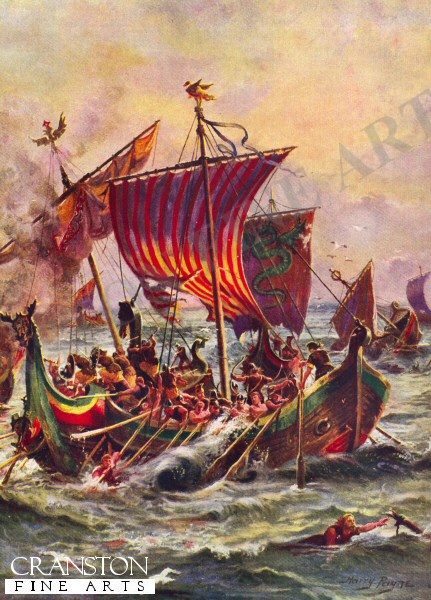
Alfreds Galleys Attacking the Viking Dragon Ships, 897 by Harry Payne (PC) In 895, Alfred captured the Viking fleet on the Lea, and drove the Danes to Quatbridge, where he besieged their camp. By the Spring they had lost all heart and the great army scattered and disappeared. Alfred then built improved war-vessels to guard against marauding Danish galleys in the Channel and during the year 897 destroyed more than twenty pirate vessels. One fight is recorded between nine of Alfreds ships and six Danish off the Isle of Wight. Historical book plate published in 1920. |
HMS Caesar Crew (PC) Officers of the Majestic class battleship HMS Caesar. In March 1912 she was part of the 4th Division, Home Fleet, rremaining with the Home Fleet until the outbreak of World War One. From 1915 to 1918 she carried out Atlantic Patrols on the North America and North Indies Station, after which she went to the Mediterranean, passing through the Dardanelles after the Armistice to support operations in the Black Sea against the Bolsheviks. |
HMS Duncan Crew (PC) Officers of the battleship HMS Duncan.HMS Duncan became a gunnery tender at Portsmouth in May 1913 before serving with the 6th Battle Squadron of the 2nd Fleet on the outbreak of war. Transferring to the 3rd Battle Squadron she moved to Portland and Dover in November 1915, but later that year moved to the Mediterranean before returning home in 1917 and going into reserve. |
HMS Rambler Crew (PC) Crew of the Royal Navy gunboat HMS Rambler. |
The Death of Nelson by William Brassey Hole. (PC) Admiral Nelson was fatally wounded during The Battle of Trafalgar by a French sniper's bullet while on the deck of his flagship. HMS Victory. Despite his severe injuries, Nelson continued to command his forces and celebrate the victory until be succumbed to his wounds later that day. His body was returned to Britain and he lay in state for three days which drew large crowds of mourners. His tomb is located in St Pauls Cathedral in London. |
HMS Wolverine Crew (PC) Stokers of HMS Wolverin c.1880. This Corvette was flagship of the Australia Station from 1875 and in 1882 was presented to New South Wales as a training vessel. |
HMS Raleigh Crew (PC) Officers of HMS Raleigh, 1873. HMS Raleigh was built with two layers of 3 inch timber with the first being applied vertically and the second being horizontal, then coppered over. The main armament of HMS Raleigh were two 9 pounder chase guns which were fitted at the extremities of the ship, and on the upper deck there were four 64 pounders in truck mounts. On the main deck were mounted 7 inch guns on the broadsides. |
HMS Leviathan Crew. (PC) Completed in 1903, the Drake class cruiser HMS Leviathan served during World War One with the 6th Cruiser Squadron and on the North America and West Indies Station. |
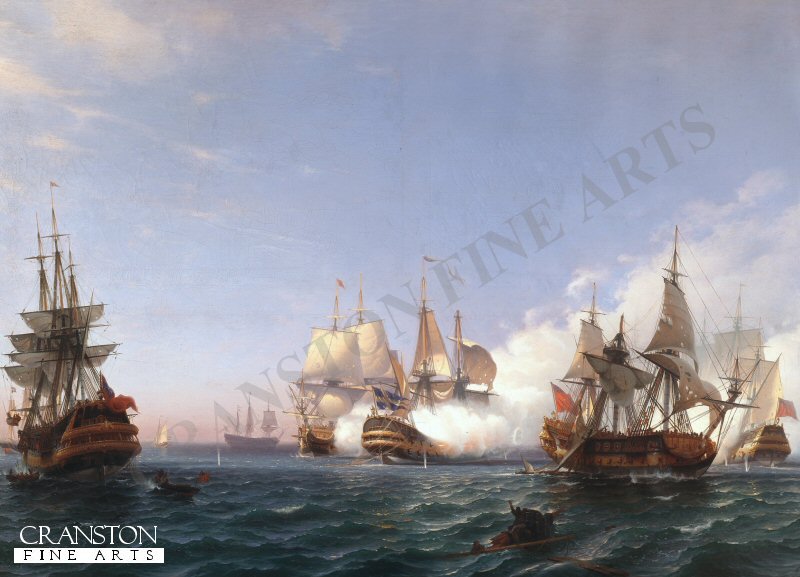
The Oland, Fighting with English Men-of-War in 1704 by Albert Berg (PC) The Battle of Orford Ness, on July 25, 1704, saw an engagement between British and Swedish vessels. The Swedish warship Oland was escorting a Swedish convoy when an English squadron approached and demanded the Swedes salute them due to their presence in English waters, however, the Swedish ships refused and a lengthy battle ensued. The Oland was captured along with its commander, eventually being released upon demand of Charles XII. The Oland sunk north of Denmark during the journey back to Sweden however. |
|
Contact Details |
|
Sign Up To Our Newsletter!
This website is owned by Cranston Fine Arts. Torwood House, Torwoodhill Road, Rhu, Helensburgh, Scotland, G848LE Contact: Tel: (+44) (0) 1436 820269. Email: cranstonorders -at- outlook.com
|
 |